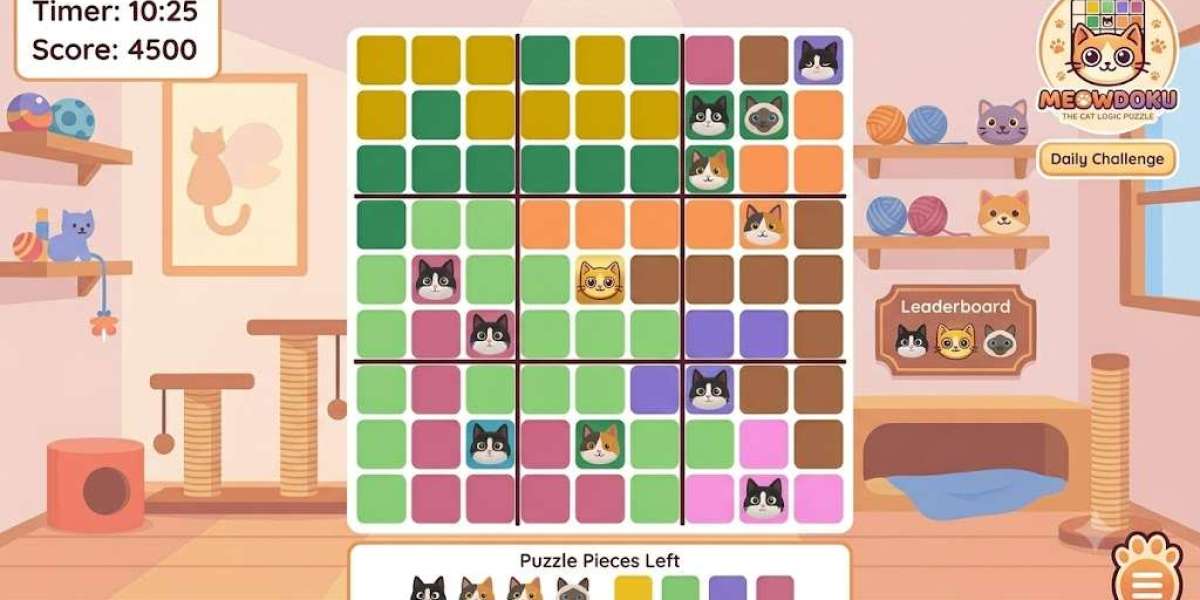

Puzzle games do not always need complicated mechanics to be enjoyable. Sometimes, a simple board, a few clear rules, and the right amount of challenge are enough to keep you playing. Meowdoku takes this idea and adds an adorable cat-themed twist to logic puzzles.
At first, the colorful board and cute cats make the game look relaxing and easy. Once you start solving a few puzzles, however, it becomes clear that every placement matters. A single cat can change the possibilities across an entire board.
What Is Meowdoku?
Meowdoku is a logic puzzle that combines Sudoku-style thinking with spatial deduction. Instead of filling a grid with numbers, you place cats in specific positions while following several rules.
The main objective is to place one cat in every colored region, while also making sure cats do not share the same row or column. Cats also cannot touch each other, including diagonally.
This combination makes Meowdoku easy to understand but surprisingly challenging to master.
Simple Rules, Interesting Puzzles
The basic rules can be learned within a few minutes.
One cat per colored region: Every colored area needs exactly one cat.
One cat per row and column: A row or column cannot contain multiple cats.
Cats cannot touch: Two cats cannot be next to each other, even at a diagonal corner.
These rules work together to create a chain of deductions. When you place one cat, you immediately eliminate several other possible positions. That can reveal another forced move somewhere else on the board.
The Fun Comes From Elimination
One of the most satisfying things about Meowdoku is watching the puzzle slowly become clearer.
You might begin with a board containing dozens of possible cells. Instead of guessing, you can mark positions that are impossible and gradually reduce the choices.
For example, placing a cat in one position can eliminate cells from its row and column while also blocking nearby cells because of the no-touch rule. The remaining possibilities then become easier to identify.
This creates a satisfying feeling of progress. You are not simply trying random moves until something works. You are building a logical path toward the solution.
Why the Cats Make a Difference
The cat theme may look like a purely visual feature, but it gives Meowdoku its personality.
Traditional logic puzzles can sometimes feel serious or mathematical. Meowdoku uses colorful regions and cute cats to create a more relaxed atmosphere while keeping the underlying challenge intact.
That makes it appealing to players who enjoy Sudoku, grid puzzles, deduction games, or short brain-training sessions but want something a little more playful.
Tips for Solving Meowdoku
If you are new to the game, the best strategy is to avoid guessing.
Start With Restricted Regions
Look for a colored region that has only a few available cells. The fewer possibilities a region has, the easier it is to determine where its cat belongs.
Check Rows and Columns
Whenever a cat is placed, immediately check its entire row and column. Those cells can no longer contain another cat.
Remember the Diagonal Rule
Do not forget that cats cannot touch diagonally. A cat can therefore eliminate more cells than just those directly beside it.
Use Marks
Marking impossible cells can make complicated boards much easier to understand. Instead of keeping every possibility in your head, you can visually track which positions have already been ruled out.
Think Before Placing
If a move is not supported by the available clues, it may be better to wait. Meowdoku rewards careful deduction more than fast clicking.
A Relaxing Game With a Real Challenge
Meowdoku has an interesting balance between relaxing presentation and focused gameplay.
The colorful board and cat theme create a cozy first impression, but solving a difficult puzzle requires concentration. You need to compare regions, rows, columns, and neighboring cells at the same time.
That makes it a good game for short breaks. You can solve one puzzle when you have a few spare minutes, or spend longer working through a particularly difficult board.
Why Players Keep Coming Back
The biggest reason to replay a puzzle game is usually the feeling of improvement.
A board that looks confusing during your first attempt can become much easier once you understand how the rules interact. You begin noticing patterns, identifying restricted regions faster, and predicting which cells will become unavailable after each placement.
Eventually, solving the puzzle becomes less about trial and error and more about recognizing the logic behind the board.
That progression is what gives Meowdoku its replay value.
Final Thoughts
Meowdoku is a great example of how a simple concept can become an engaging puzzle experience.
The rules are straightforward: place cats in the correct regions, keep them out of the same rows and columns, and make sure they never touch. But combining those rules creates plenty of opportunities for deduction and increasingly challenging decisions.
If you enjoy casual logic games and want something that feels lighter and more playful than traditional Sudoku, Meowdoku is worth trying.
The cats may look cute and harmless, but solving a difficult board can require some serious thinking.